
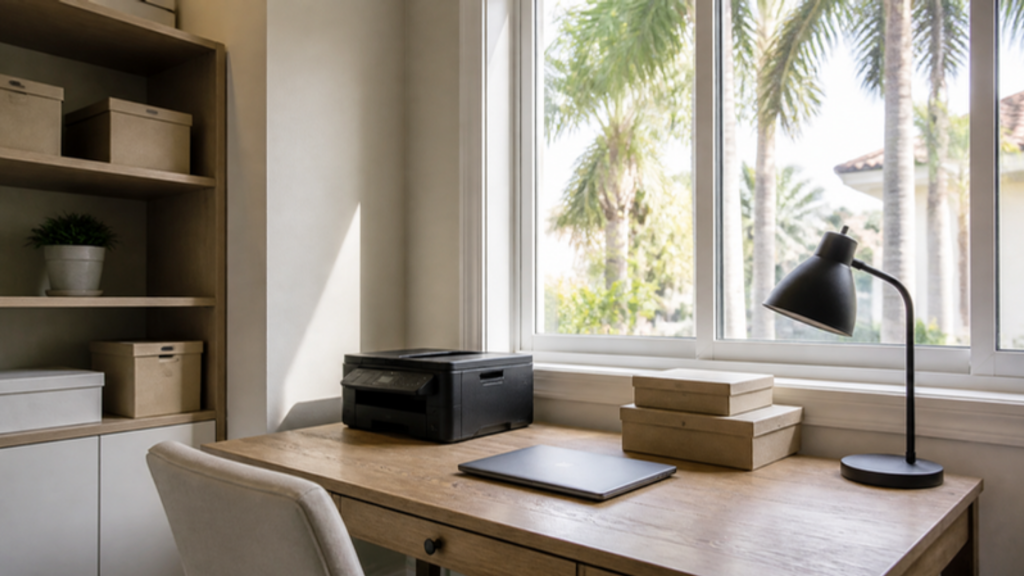
Maybe you design websites from a spare bedroom, sell baked goods or candles online, tutor students at your dining table, or keep tools and inventory in the garage for a side business. Working from home is common across South Florida, and many people assume their homeowners policy follows them into that work. Often it only partly does. Before you rely on it, it helps to understand how home-based business insurance fits with the policy you already have, and where the usual gaps are.
This guide explains how a standard homeowners policy typically treats business property and business liability, what counts as a “business” in the policy’s eyes, and the main ways home-based business owners close the gaps.
Why a homeowners policy is not built for your business
A homeowners policy is designed to protect a residence and the household’s personal belongings and personal liability. Business activity changes the risk: more equipment and inventory in the home, customers or clients coming to the door, products leaving the house, and professional advice that someone could later question. The National Association of Insurance Commissioners notes in its consumer guidance on working from home that business-related property losses and liability exposures are typically excluded from, or limited under, a traditional homeowners policy.
Policies differ by insurer and form, so the details below describe how standard forms commonly work. Your own declarations page and policy wording are what actually apply. If you want a refresher on the main parts of a policy first, see our guide to what homeowners insurance covers in Florida.
Gap 1: business equipment and inventory have a low special limit
Personal property coverage usually has “special limits” for certain categories, and business property is one of them. In the widely used ISO homeowners form (HO 00 03, sample published by the Insurance Information Institute), property used primarily for business is limited to $2,500 while it is on the residence premises and $500 while it is away from the premises. The Insurance Information Institute describes the same typical $2,500 limit for business equipment.
That can disappear quickly once you add up a computer, a printer, a camera, specialized tools, or a few months of inventory waiting to ship. Some insurers use different amounts or wording, so check the “special limits” section of your own policy. This works much like the sublimits on jewelry and other valuables we described in our article on insuring valuable items in Florida.
Gap 2: liability from business activity is usually excluded
The bigger issue is often liability. The standard ISO form’s personal liability section excludes bodily injury and property damage “arising out of or in connection with a business” conducted from an insured location, with narrow exceptions. In practice, that means situations like these may fall outside a homeowners policy:
- A client slips on your front steps on the way to a meeting in your home office.
- A product you made or sold is claimed to have caused an injury or damage.
- A customer says your advice or work caused them a financial loss.
The last example points to professional liability (errors and omissions) coverage, which a homeowners policy is not designed to provide. The Insurance Information Institute notes that professionals working from home will often need it. A personal umbrella policy usually does not fill this gap either, because many personal umbrella policies exclude business activities. Our article on personal umbrella insurance in Florida explains what an umbrella is designed to do.
“It’s just a side hustle” may still count as a business
Many people assume these limits only apply to a full-time company. In the standard ISO form, “business” means a trade, profession or occupation engaged in on a full-time, part-time or occasional basis, and other paid activities as well. The form makes limited exceptions, such as activities that brought any insured no more than $2,000 in total compensation in the 12 months before the policy period, certain volunteer work and some unpaid home day care. Weekend sales, freelance projects or a seasonal side business can easily fall inside the definition. Your policy’s own definition controls, so it is worth reading.
Being allowed to run a business at home is a separate question
Florida law is generally friendly to home-based businesses. Under section 559.955, Florida Statutes (2026), a qualifying home-based business may operate in a residential zone, and local governments are limited in how they can restrict it. The statute does not override condominium, cooperative or homeowners’ association documents, so those rules still matter.
Keep in mind that zoning and insurance are different issues. A business that is perfectly legal to run from your home can still sit outside your homeowners coverage. The NAIC also notes that not telling your insurer about a substantial business at home may lead to a denied business-related claim or a nonrenewal, so a short conversation about how you use your home is worthwhile.
Common ways to close the gaps
The right fit depends on what you do, what you own, who comes to your home and how much revenue the business brings in. The options typically look like this:
- A home business endorsement. Some insurers allow an add-on to the homeowners policy that raises the business property limit and, for low-traffic businesses, may add limited business liability. Availability and terms vary by insurer.
- An in-home business policy. According to the Insurance Information Institute, these policies generally offer broader liability limits and may include coverage for lost income and extra expenses after a covered loss.
- A business owners policy (BOP). A BOP packages property, business interruption and liability coverage for many small businesses, including those that grow beyond a home office. It does not include workers’ compensation or business auto coverage.
- Separate coverages as needed. Professional liability for advice-based work, workers’ compensation if you hire employees, and a review of your auto policy if you use your car for deliveries or client visits.
You can see the business coverages our team works with on our business insurance page.
A five-question check before you talk to your agent
- What equipment, tools and inventory do you keep at home, and roughly what would it cost to replace them?
- Do clients, customers or delivery drivers come to your home for the business?
- Do you make, sell or ship products, or give advice that clients rely on?
- Do you have employees or contractors, or use your vehicle for business errands?
- Do you rent your home or live in a condo or HOA community with its own rules?
Your answers make it much easier to see whether an endorsement is enough or whether a separate business policy makes more sense. Renters and condo owners should ask the same questions, because renters and condo policies commonly carry similar business limits.
Talk it through with our team
If you run a business from home, or are about to start one, we can review your current homeowners, condo or renters policy with you, explain where its business limits apply and walk you through the coverage options and a quote.
EZ Assurance Group, Inc.
Phone: (954) 493-1110
Email: info@ezassurancegroup.com
Website: ezassurancegroup.com
Facebook: facebook.com/EZAssuranceGroup
Instagram: instagram.com/ezassurancegroup
LinkedIn: linkedin.com/company/ez-assurance-group-inc
Disclaimer (October 2026): This article is general information about how homeowners insurance commonly treats home-based business activity in Florida. It does not describe or change the coverage of any specific policy, and it is not legal or tax advice. Coverage, definitions, exclusions, limits, endorsements and eligibility vary by insurer and depend on the actual policy terms and underwriting. Policy form references are to the ISO HO 00 03 sample form published by the Insurance Information Institute; statute references are to section 559.955 of the 2026 Florida Statutes. Sources were current when published and may change. For questions about zoning, licensing or association rules, consult your local government, your association or a licensed attorney.